Economics_RS Class 09
A BRIEF OVERVIEW OF THE PREVIOUS CLASS (05:03 PM)
QUESTION (05:06 PM)
- Question:- What is inflation targeting? Do you think Inflation targeting is an appropriate mechanism for deciding monetary policy? Discuss (10 marks/ 150 words).
- Approach:-
- Define Inflation targeting- [* Inflation targets fixed by the Government in consultation with RBI every 5 years @ CPI combined ]
- Give the context of the Urjit Patel committee because of Dual Dilemma faced by the RBI
- Here the keyword is 'discuss', so give positive and negative and also give a conclusion.
- Also give some current related way forward.
WHY CPI IS USED FOR INFLATION TARGETING? (05:08 PM)
-
Production (transportation) Wholesaler (Taxes and subsidies) Retailer/ consumer PPI @ production level WPI@ wholesale level CPI@ consumer level - Across the globe, it is a standard practice that Inflation is taken at the consumer level.
- CPI combined= CPI@ rural level + CPI@ urban level
- For measuring inflation, a basket of commodities will be considered.
-

- The highest weight is given to food and beverages. [* Why?- It is based on per capita consumption]
- This inflation should be in the range of 2% to 6%
- Challenges of taking inflation targeting for using Monetary policy
- Over-focus on inflation may affect economic growth.
- Inflation targeting can not be successful because of inefficient monetary transmission.
- RBI alone can not handle inflation unless there is coordination between fiscal policy and monetary policy as fiscal stimulus also affects inflation.
- [* Example- Schemes like MGNREGA also increase inflation and this is not in control of RBI]
- In CPI combined maximum weightage is given to foods and beverages and the price of these foods and beverages are linked to the cost-push/ supply side and these can not be handled by RBI. It is beyond the control of RBI.
- [* RBI is good at handling the demand side problems, monetary policy focuses more on the demand side. It handles demand-pull inflation. RBI can not do anything when OPEC country is increasing the oil prices or the Russia-Ukraine war is happening ]
- Positives of Inflation targeting
- Inflation affects the poor man more.
- It affects growth as consumption drops.
- High inflation goes against the GDP.
- It will have an impact on currency value.
BENEFITS OF EXTERNAL BENCHMARKING (05:40 PM)
- External Benchmarking will make the interest rate transparent.
- External systems will ensure monetary transmission i.e. any policy rate cut will reach the borrower faster
- Banks are free to decide spread over the external benchmark, however, the interest rate must be changed as per the external benchmark once every three months.
- [** For effective monetary transmission i.e. when RBI is increasing the REPO rate from 4 to 6.5 % then two things must happen
- a) Interest rates on loans such as car loans and home loans must increase and
- b) Interests on deposits by retail customers should also increase.
- Then we can say there is effective monetary transmission **]
MARGINAL STANDING FACILITY (05:50 PM)
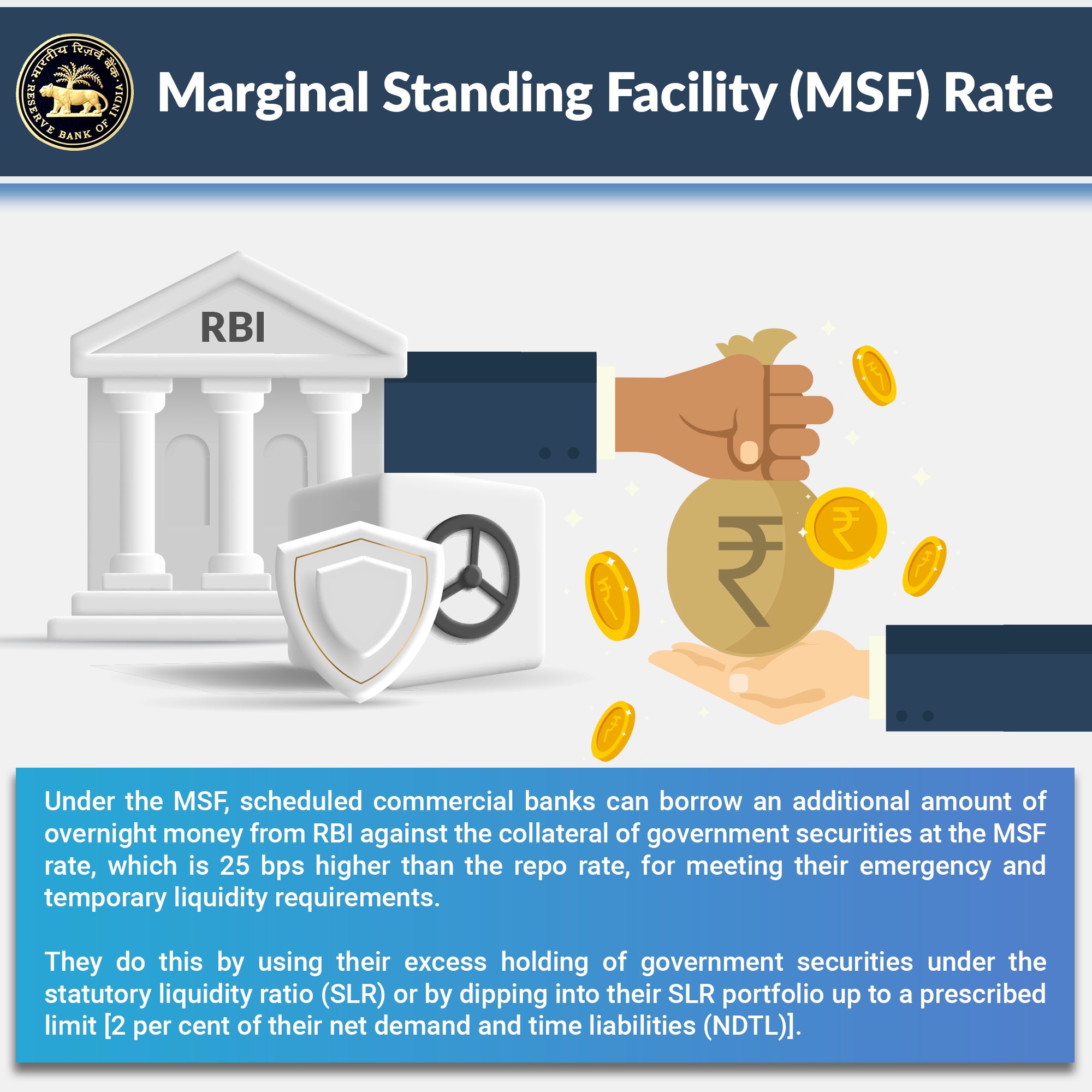
- It is also a short-term borrowing mechanism (Overnight).
-
-
REPO MSF Short term Overnight It is used in Emergency situations Banks+ Financial institutions It can be availed by Commercial banks No upper limits The upper limit is 3% of NDTL (earlier it was 2% ) No upper limit fixed Multiples of 1 cr (1 cr, 2 cr, 3 cr ) This is applicable only when there is G-sec Securities under SLR can be pledged under MSF up to some extent - It refers to the rate at which banks can borrow overnight funds from RBI
- It was introduced by RBI in its credit policy in May 2011. Banks have to exchange securities with RBI to avail of overnight credit through MSF.
- The maximum Credit a bank can avail through MSF is 3% of its NDTL (Net demand and time liability).
- The difference between MSF and reverse Repo is called the Spread of lending and borrowing rates of RBI or the Corridor.
- Currently, the MSF rate is 6.75% and MSF is merged with the Bank rate.
-

- During the COVID period, the reverse repo rate was decreased to 3.35% (base reverse repo rate) as RBI was discouraging the banks to park the excess cash with the RBI.
- During COVID, the RBI was changing the REPO rate, MSF rate, and SDF rate and not changing the Reverse repo rate.
BANK RATE (06:29 PM)
- It is the interest rate at which RBI lends money to banks and other financial institutions for a long-term period.
- Currently, bank rates are not used for policymaking, rather they are called as penalty rates or penal rates.
-
REPO rate MSF Reverse REPO SDF Bank rate Term Short term Short term Short term Short term Long term G-sec Required required Required Not required Not required Rate 6.5 6.75 3.35 6.25 6.75 - Note:- Fixed reverse REPO rate- Currently fixed reverse repo is not used as a standard tool as RBI is depending more on a standing deposit facility. Currently, the gap between SDF and MSF is the corridor that is the spread of the borrowing and lending mechanism of RBI.
STANDING DEPOSIT FACILITY (06:33 PM)
- It is a mechanism through which RBI absorbs excess cash in the hands of the bank without the obligation of securities. Unlike the Reverse Repo rate, RBI need not pledge securities to borrow money from banks.
- The amount maintained by banks under SDF can be seen as part of the SLR requirements of banks.
- SDF was 6.25%.
-

- Question- What is the monetary transmission? What measures have been taken by RBI in the recent past to ensure monetary transmission? (10 marks/ 150 words).
- Question- Can market economies become inclusive? What is the role of financial inclusion in increasing the economic growth of the country? (10 marks/ 150 words).
QUALITATIVE TOOLS (06:40 PM)
- These are tools that are used for selective credit controls
- a) Consumer credit regulation-
- b) Margin requirements
- c) Credit rationing
- d) Moral suasion
- e) Direct action
- RBI uses three stances
- a) Accommodative stance- REPO either will be decreased or it will be kept the same (status quo) but it will not be increased. It is done when the focus is on increasing growth.
- b) Neutral stance- It will be increased or decreased based on the situation
- c) Calibrated tightening- Here trying to deal with inflation. Here either the REPO will be increased or it will be kept as it is but not reducing the REPO rate.
- Hawkish stance-
- In the International Economy
- The target is inflation by keeping growth in mind.
CURRENT UPDATE (07:14 PM)
- The reverse REPO rate is fixed (3.35%) and RBI has kept an upper limit to the Reverse REPO rate i.e. accepting up to 2 lakh crore. It was done as RBI may not have enough G-secs. This was also one of the reasons for bringing SDF.
- RBI also came up with variable reverse repo rates. Now RBI is almost discarded using the Reverse Repo and focusing on SDF (which is 6.25% ).
- Now the lower margin is SDF and the upper margin is MSF. This gap is called CORRIDOR.
- The money put under the SDF will be counted as the SLR but it can not be kept as CRR.
- LTRO- Long-term REPO operations and Term REPO- During the COVID times.
-

- Concept of Spread
-

QUALITATIVE TOOLS/ SELECTIVE CREDIT CONTROL (07:42 PM)
- It mainly focuses on discriminating between essential and non-essential sectors. The banking regulation Act 1949 has given extensive regulation powers to RBI to apply qualitative tools
- Fixation of margin requirement
- It was introduced for the first time in 1956, the term Margin denotes that part of the amount which can not be borrowed from banks. This portion has to be borrowed by the borrower himself (Own sources).
- For example-
- Case 1- Where the person wants a 1 cr loan and the bank is offering a loan of 70 lakhs and 30 lakhs can be arranged by an individual on its own without the assistance of the bank
- Case 2- Where the person wants a 1 cr loan and the bank is offering a loan of 80 lakhs and 20 lakhs can be arranged by an individual on its own without the assistance of the bank
- In case 2, the margin requirement is less, more chances of economic growth. When the margin requirement is more it means the focus is on controlling inflation.
- Loan to value- While keeping 1 kg gold- getting 80 lakhs as a loan. [* If only 40 lakhs are given as a loan it means RBI is trying to handle inflation]. Reducing the loan to value means RBI does not want to give more loans.
- RBI has the power to vary the margin requirement depending upon the business conditions prevailing in India i.e. during an inflationary period RBI raises the margin and during a deflationary period, it lowers the margin to boost growth.
- Consumer credit regulation
- Under this method, consumer credit is regulated through instalments and down payments. Even the loan duration is fixed in advance to check credit and handle inflation in the economy.
The Topic for the next class:- Continuation of the Qualitative tools.